Back to Home

Events & Workshops

From Prompt to Agent — Your First Intelligent AI System

18 April 2026
University of Hertfordshire, UK

A full-day hands-on workshop on Agentic AI at the University of Hertfordshire — designing, building, and deploying intelligent AI agents capable of autonomous decision-making.

Full-Day Workshop on Agentic AI

A full-day workshop on Agentic AI at the University of Hertfordshire on the 18th of April 2026 — a day truly full of agentic AI.

It was inspiring to see 55 highly talented students join us in person, alongside an incredible 140 hours of online engagement. What a truly wonderful day it was — full of energy, ideas, and meaningful progress.
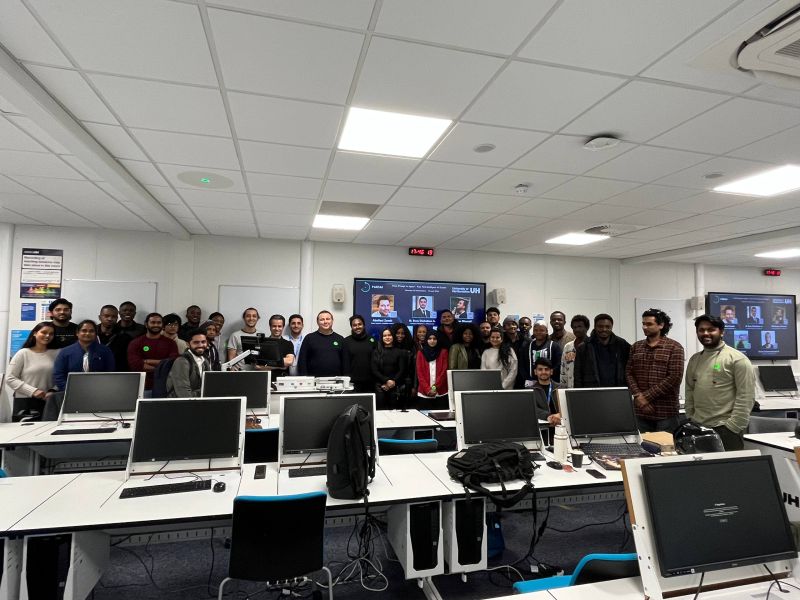
Workshop attendees at the University of Hertfordshire

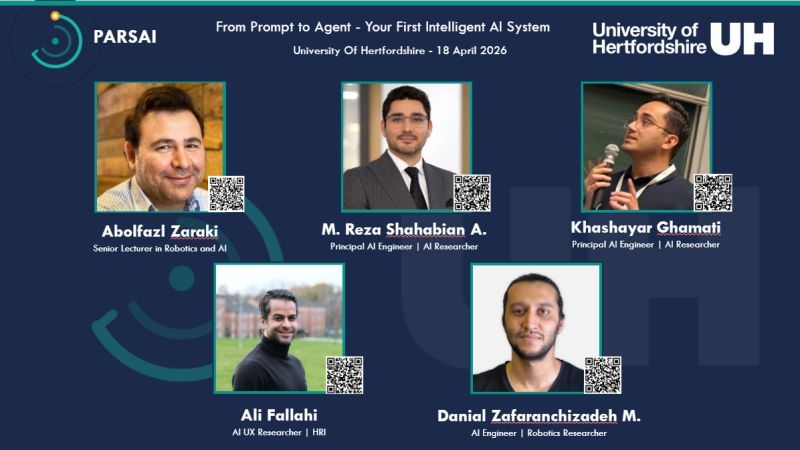
Speakers — From Prompt to Agent, PARSAI × University of Hertfordshire


About the Workshop

Dive into the world of Agentic AI and discover how to design, build, and deploy intelligent AI agents capable of autonomous decision-making. This workshop takes you step-by-step through the foundations of agentic systems, including architecture design, Retrieval-Augmented Generation (RAG), and real-world applications.

Through live demonstrations and practical insights, you’ll learn how modern AI agents are built and applied across different domains. Whether you’re a developer, AI enthusiast, or tech innovator, this session gives you hands-on experience and a deeper understanding of agentic AI.


What You Will Learn

  • What Agentic AI is and how it differs from traditional AI
  • Core components of AI agents: LLMs, tools, memory, orchestration
  • Introduction to RAG systems and agent architectures
  • Practical examples and live coding demonstrations

Speakers

  • Abolfazl Zaraki — Senior Lecturer in Robotics and AI
  • M. Reza Shahabian A. — Principal AI Engineer | AI Researcher
  • Khashayar Ghamati — Principal AI Engineer | AI Researcher
  • Ali Fallahi — AI UX Researcher | HRI
  • Danial Zafaranchizadeh M. — AI Engineer | Robotics Researcher

Workshop Timeline

Jump to any section of the full recording on YouTube:


Watch & Join

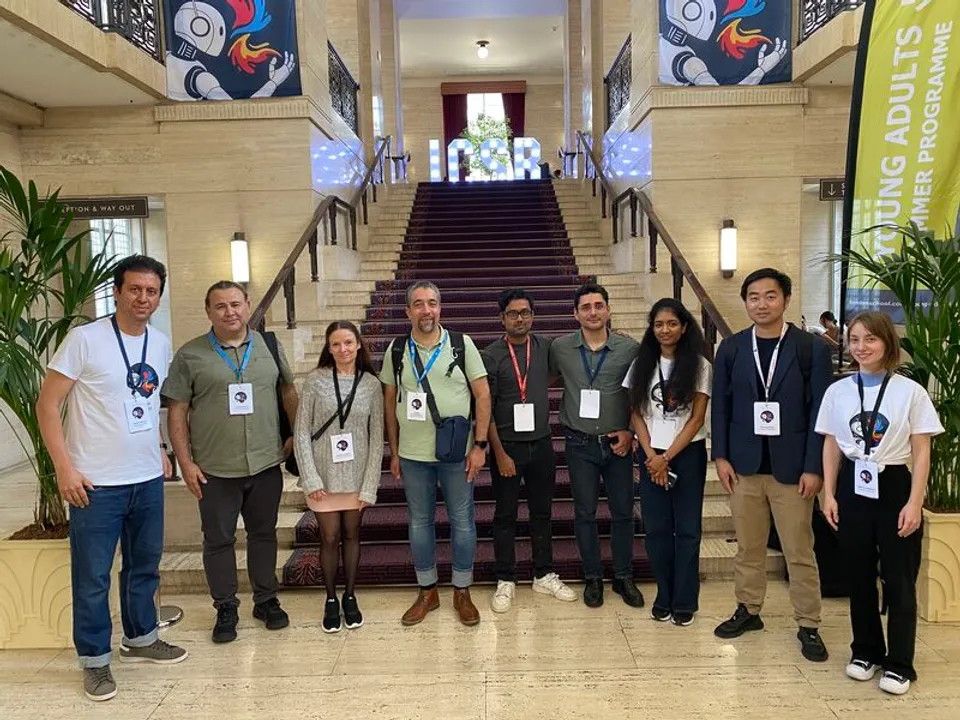
ICSR 2026 — Special Session: Assistive Robotics and Exoskeletons for Human Augmentation and Wellbeing

ICSR 2026 — Special Session: Assistive Robotics and Exoskeletons for Human Augmentation and Wellbeing

1-4 July 2026
University of London, London, UK

Building interdisciplinary bridges through assistive technologies, social robots, and creative therapies

18th International Conference on Social Robotics

Special Session: Assistive Robotics and Exoskeletons for Human Augmentation and Wellbeing

Conference Details

  • Conference: 18th International Conference on Social Robotics (ICSR 2026)
  • Dates: 1–4 July 2026
  • Location: University of London, London, UK

Organisers

  • Farshid Amirabdollahian
  • Mohamad Reza Shahabian Alashti
  • Shadiya Alingal Meethal
  • Patrick Holthaus
  • Gabriella Lakatos

All organisers are affiliated with the Robotics Research Group, University of Hertfordshire, UK.


My Contributions

I chaired the Social Assistive Robotics in Art and Health session, and contributed to four papers presented at this special session:

  • 📄 Vision–Language Model for Fall Detection in Socially Assistive Robotics: Zero-Shot Prompting and Few-Shot Calibration — Shahabian Alashti, M. et al.
  • 📄 From Pilot Data to Protocol: Sample-Size Guidance for Multimodal Intent Detection in Assistive Wearable Robotics — Shahabian Alashti, M. et al.
  • 📄 EMG-Based Lower Limb Activity Recognition for Exoskeleton-Assisted and Unassisted Locomotion Using Deep Learning — Alingal Meethal, S. et al.
  • 📄 Pexformer: Robust Indoor Human Localisation via Patch-Level Tokenisation and Semi-Permeable Attention — Zhang, B. et al.

Description

This special session bridges the fields of assistive robotics, rehabilitation, and social human–robot interaction, with an invitation to explore new intersections with creative and expressive therapies. As the field of social robotics matures, it becomes increasingly important to consider not just how robots assist physically, but how they engage, empower, and emotionally support users in therapeutic contexts.

We focus on wearable robotic systems—such as exoskeletons, soft exosuits, and intelligent assistive devices—designed to enhance physical function, facilitate recovery, and promote independence in both clinical and everyday environments. These systems often integrate biosignals (EMG, EEG, IMU), deep learning models, and co-adaptive control for personalised support.

In addition to traditional rehabilitation, this session also invites contributions at the interface of assistive robotics and creative therapies, including art therapy, where social robots and assistive technologies are designed to support cognitive, emotional, and expressive goals. From supporting movement through collaborative painting to enabling voice and gesture in therapeutic storytelling, we aim to foreground how social and wearable robots can participate in multimodal, human-centred healing practices.

This session embraces ICSR’s mission of advancing socially intelligent robotics while building bridges with fields such as occupational therapy, cognitive neuroscience, digital arts, and healthcare design.


Key Themes

  • Wearable Assistive Robotics: Exosuits and exoskeletons for daily support and motor recovery
  • Multimodal Sensing and Intent Detection: EMG, EEG, IMU, and biosignal integration
  • AI-Driven Adaptation: Deep and meta-learning for real-time, personalised assistance
  • Human–Robot Interaction in Rehabilitation and Art-Based Therapies
  • Social Robots in Creative and Complementary Therapy: Use of robots in art therapy, music-based interventions, or storytelling
  • Ethical and Inclusive Design: Trust, long-term use, accessibility, and identity-sensitive interaction
  • Real-World Evaluation: Clinical trials, longitudinal studies, and deployment in care and cultural settings
  • Benchmarks and Frameworks: Open datasets, replicability, and cross-domain methodological tools

Submission

For the conference submission, authors can submit their papers to the appropriate Special Session via the ICSR conference submission system, using the designated SS code. Each paper will undergo a peer-review process managed by the special session organisers, who will invite at least two independent reviewers for each submission. Based on the reviewers’ evaluations, the SS organisers will decide whether to accept or reject.

Accepted papers for Special Sessions will be included in the conference proceedings, published by Springer International Publishing in the Lecture Notes in Artificial Intelligence (LNAI) series — a topical subseries of the Lecture Notes in Computer Science (LNCS). The proceedings will be indexed in SpringerLink and Scopus.

Read more about special sessions and submit your paper via the ICSR 2026 website.